
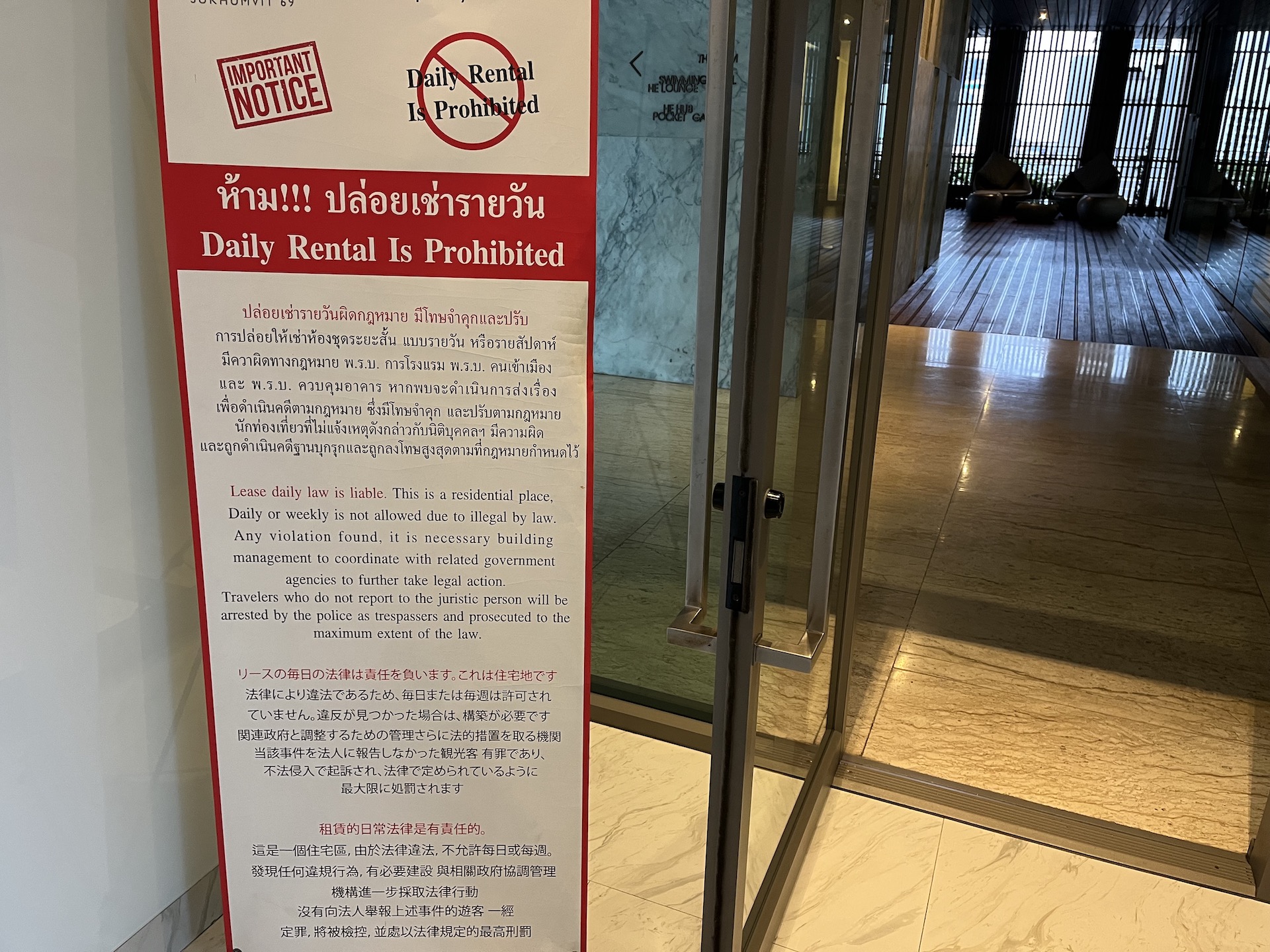
Popular Air BnB bookings aren’t always compliant with local laws and building regulations, which can result in cancellation or evictions and many condomiums in Thailand are now cracking down on this.
These past few months I have personally witnessed active enforcement and eviction at my own condominium building with police officers being involved after commotion ensued during the interaction.
Owners can easily list a property on Air BnB and there is very little control over what happens once a home has been rented out but keep in mind that you might be skating on thin ice when it comes to legal compliance.
Issued start to deleveop when other residents complain to the authorities or the building management about the temporary tenants who are then usually kicked out of the property and the owner is fined.
The problem is two-fold. For one, owners should know when their city/state/building prohibits renting out private residences on a temporary basis and follow the laws in place.
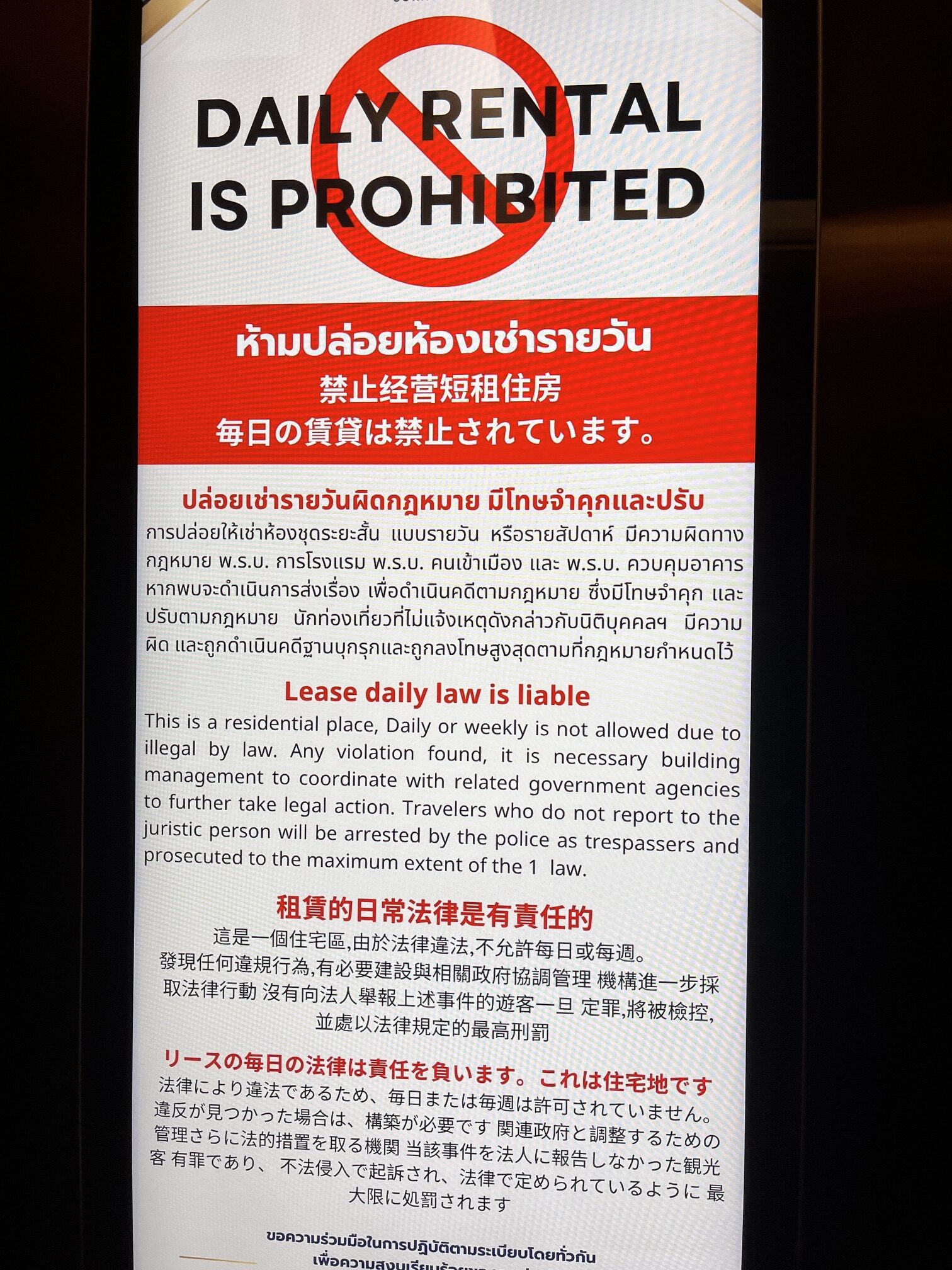
My condo in Thailand has now stepped up enforcement of the rules following the most recent owners meeting and several units were already subject to eviction, one involed the police being called on Monday afternoon.
Notices are posted in the lobby, the pool entrance and in the elevator:
Air BnB customers mistake their stay for being in a hotel, thinking they can make noise and behave the same way as they would in a hotel where there is staff to clean up after them.
Private residences don’t work that way. People living there are at home and, as such, expect a reasonable amount of privacy, noise constraints, safety, and cleanliness on the premises.
Air BnB actually has a notice on its website to that effect. General regulations and permissions
It’s important to make sure you’re allowed to host on your property. Some examples of restrictions include contracts, laws, and community rules. Check with a lawyer or local authority to learn more about regulations, restrictions, and obligations specific to your circumstances. Thailand has laws and regulations that may affect short-term rentals. Please check the relevant laws and regulations for compliance, including the Hotel Act, B.E. 2547 (2004), the Building Control Act, B.E. 2522 (1979), the Public Health Act, B.E. 2535 (1992), and other relevant provincial regulations.
For example, please take note of the 2008 Ministerial Regulation under the Hotel Act, B.E. 2547 (2004), which states that short term property rentals shall not require a hotel license if:
The property has four rooms or less; The property can accommodate a maximum of twenty guests or less; and The rental of such property merely provides an additional source of income for the owner
If you are eligible for this exemption, please notify your local authorities by completing the form here. For a step by step guide, you may refer here.
Hosts operating property rentals under this exemption must still report their rental activity to the relevant local authorities. A failure to report is subject to significant fines and penalties. If the property is located outside of Bangkok, the activity should be reported to the Provincial Governor’s Office via the local District Office where the property is located.
If the property is located in Bangkok, it should be reported to the Department of Provincial Administration at the following address:
Order Maintenance Division 3
Investigation and Legal Affairs Bureau
Department of Provincial Administration
442 Nakornsawan Road, Kwaeng Si Yak Maha Nak, Khet Dusit
Bangkok 10300
You can use the general info in this article as a starting point to learn about hosting regulations and permissions.
Registration of foreign guests
Section 38 of the Immigration Act B.E. 2522 (1979) requires hosts to notify the Thai Immigration Bureau, Royal Thai Police, or the local immigration offices where a foreigner stays either by online notification or by using the Form TorMor. 30. This notification must be done within 24 hours upon the foreign guest’s arrival. Non-compliance with this notification requirement may result in a fine of up to THB 2,000.
So that’s the company’s way of wiping their hands clean, saying, “we spelled it all out, it’s your responsibility to be familiar with the law”. Yet, the company does nothing to prevent such illegal rentals, for example by requesting the license or exemption from the owner before allowing a listing to go live.
And AirBnB isn’t the only platform, you can now book private homes on websites such as Booking and Agoda as well which is all nice and well – until it isn’t. It’s usually due to the behavior of the guests when problems develop, but sometimes even new people showing up with suitcases is enough for someone to report it to the juristic office.
Long-term rentals of a month or longer are permitted, so that’s definitely a valid exception. Still, the host/owner of the Air BnB has to properly register such a resident with immigration and the condo management office.
Conclusion
Travelers should familiarize themselves with the rules and regulations for Air BnB rentals in their destination country and city. I would not rely solely on what the host says, hosts are out to make quick money, but they often aren’t forthcoming that being an Air BnB guest at their property is actually illegal.
Being kicked out of your accommodation at night, having to find a hotel last second, paying fines, and then trying to get a refund from Airbnb isn’t exactly how most of us would like to experience and remember our vacation.
Especially more upscale properties in Thailand are now sensitive about these rules and many (including my own condo) have started to aggressively enforce the rules, including the involvement of the authorities.